
 |
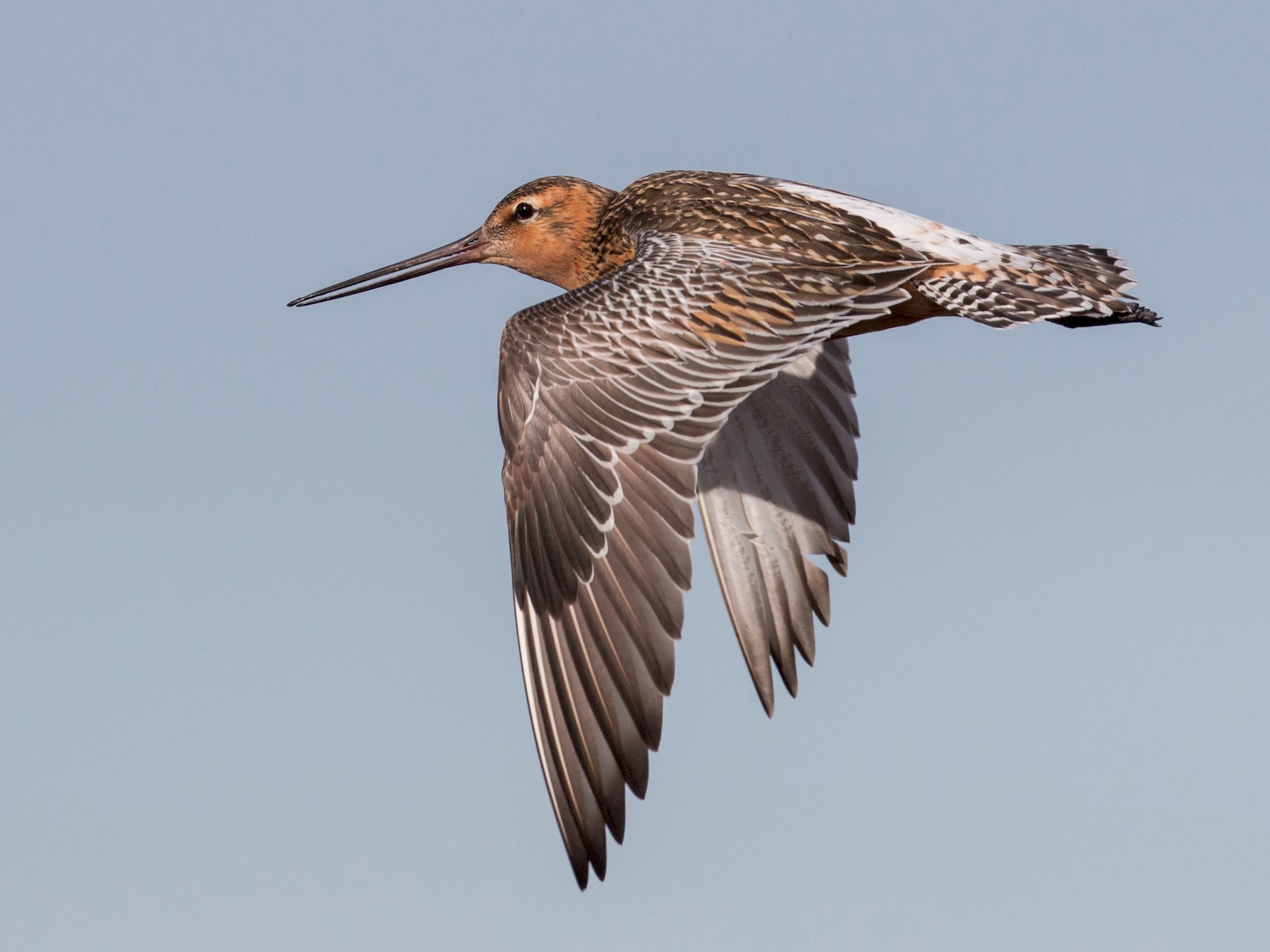
| Bar-tailed godwit in flight |
“Look! Up in the sky!”
Birds
are often considered remarkable – for their beauty, their intelligence or
inventiveness, their song. How about if
they hold the distance record for their non-stop migration flight: 7,000 miles? Especially if they do it without food, water
or rest for eight to 10 days and nights, through all kinds of weather?
Bar-tailed
godwits, truly remarkable birds, annually travel from Alaska to New Zealand to breed
and raise their young. Then, duty done, they
fly back to Alaska, apparently never asking “Is this trip really necessary?”
Talk
about “extreme sports”!

Shaped
something like missiles with aerodynamic wings and bodily changes that
facilitate their travels – including carefully added body fat that fuels their
flights — godwits fly non-stop from
Alaska over the Pacific to Hawaii, then Fiji, till they reach New Zealand’s
beaches.
While
their navigation system is still uncertain, there’s no doubt godwits have one,
and their young somehow catch on when they fly north to Alaska. It’s estimated that some 90 thousand birds
make the annual trip for more food and fewer predators – and 90% make it.
Only through greatly improved
technology in recent years have scientists become able to track such bird
flights. Now, they can follow individual
birds in real time. https://tinyurl.com/25na9s6r
Now
the “good guys”

Beavers:
devils or angels? These days, they’re trending toward angels, especially in
parts of the country experiencing drought.
“Water” is the magic word.
 |
In
the bad old days for beavers, their dams often foiled farmers’ plans so they were
sometimes dynamited or otherwise destroyed, and the federal government killed
the animals – nearly 25 thousand of them last year.
Gradually,
people started seeing advantages to beaver dams and began to happily co-exist: dam pools provide water for livestock and
wildlife during droughts; they slow down destructive torrents of water raging
down mountain sides; and they turn creeks into wetlands, clean the water and serve
as buffers against wildfires. In some places
where their dams aren’t needed, beavers are being relocated to areas where they
are — people are learning to “leave it to beavers.” https://tinyurl.com/52b9tk9n
Dogged
about accuracy
Last
week’s post included an entry about “teenage dogs,” as identified by Dr. Alexandra
Horowitz, a dog behavior expert. I
captioned the accompanying image of a black dog “Quid,” assuming that’s who it
was. Then, from a review of Horowitz’s new
book, The Year of the Puppy, I learned I was wrong because it includes a
photo of the real “Quid,” short for “Quiddity,” btw.
That
rebellious-ready black dog must have been a stand-in. Maybe even another teen dog. https://www.nytimes.com/2022/09/18/books/alexandra-horowitz-year-of-the-puppy.html
A
happy end note

The
heroic job of rescuing some 4,000 beagles from a Virginia breeding facility that
supplied animals for experimentation is finished, thanks to the HSUS and its
partner organizations around the country.
Beagles who would have been used, abused and killed are now starting
real lives in loving homes.
Linked below, the video stars
some of the rescued beagles learning to play; it’s followed by a few flashbacks
to the huge, widespread efforts on their behalf. https://www.youtube.com/watch?v=MgCOdi7pRn0
Shuttle
off to . . . sterilization
As the state’s central resource for information on
community cats and Trap-Neuter-Return (TNR), the Animal Protection League of
New Jersey (APLNJ) also encourages and assists with implementation of that
program.
Now, seeing a need to transport large numbers of cats
through the TNR process, the organization is offering a shuttle service next
Tuesday, Oct. 4. APLNJ subsidizes costs
so the total price of $60 per cat ($70 for no ear tip) also includes a microchip.
If demand continues for shuttles-to-sterilization, the
service will too. (https://aplnj.org/tnr/)
